
The problem with paper time cards in a fabrication shop isn't the paper. It's what happens after the paper: a manager sits down on Thursday or Friday, stacks of cards in front of them, and tries to reconstruct which jobs each person worked on and for how long. That reconstruction process — not the card itself — is where payroll errors come from, where job cost data goes wrong, and where manager hours disappear every week.
Replacing paper with a digital equivalent that still requires end-of-week reconstruction doesn't solve the problem. The reconstruction step is what needs to go.
The Fabrication-Specific Failure Mode
Paper time cards work differently in fabrication than in office environments. An office worker logs hours against a project after the fact because they spent most of the day on that project. The reconstruction is close to accurate.
On a fabrication floor, a single worker might touch three or four jobs in a shift. A welder who starts the day on a structural beam order, pivots to a rush repair job at 10am, returns to the beam order after lunch, and picks up a small custom bracket job at 3pm has four work segments that need to be attributed correctly. The paper card captures: "Bob — 7am to 3:30pm."
That's where the reconstruction problem starts. On Friday, the manager or shop admin reviews Bob's card and tries to remember — or asks Bob — how many hours went to which job. Bob might remember roughly. He probably doesn't remember precisely. The structural beam order gets 5 hours, the repair job gets 2, the bracket job gets 1. That's 8 hours total, which matches the card. But were those numbers right? Nobody knows.
This pattern repeats across every worker, every shift, every week. The cumulative error in job cost data is substantial — not because the workers are dishonest, but because human memory of time allocation decays within hours, let alone across a week.
What the Reconstruction Step Actually Costs
The cost shows up in three places.
Job costing accuracy. Every job your shop quotes is estimated against historical labor performance. If the hours attributed to previous jobs were reconstructed from memory, your historical data is imprecise. You're quoting new jobs against imprecise history. Job costing that relies on reconstructed labor hours isn't job costing — it's educated guessing.
The American Payroll Association has found that manual payroll processes carry error rates of 1–8% — a range that includes both over- and under-payment. In a 30-person shop with average weekly payroll of $25,000, that's $250–$2,000 in error per week. Most shops absorb this as cost of doing business because they don't have a mechanism to measure it. The paper card makes it unmeasurable.
Payroll processing time. Every pay period, someone — usually the shop admin, sometimes the owner — spends hours processing paper cards. Card collection, legibility issues (cards that got wet, got grease on them, fell on the floor), workers who forgot to fill in their card, late submissions from the previous Friday. Then the data entry. Then the reconciliation against the job list. The SHRM has documented that organizations relying on manual time and attendance tracking spend an average of 4–7 minutes per employee per pay period just on error correction — before accounting for the original data entry.
Manager capacity. The person doing the reconstruction is often the person most capable of doing something else. Shop owners and ops managers who spend two to three hours every Friday on time card processing are not doing production planning, customer calls, or quoting. The labor hours spent on reconciliation don't show up on any job — they're overhead that compounds every pay period.
The Right Solution: Attribution at Clock-In
The reconstruction problem has a direct fix: capture job attribution when the work starts, not when the week ends.
When a worker clocks in, they should be selecting a job — not just punching a time clock. When they switch jobs mid-shift, they clock out of the current job and clock into the next one. Each segment gets a start time, an end time, and a job. There's no reconstruction because there's nothing to reconstruct: the record already shows which hours went where.
This is how FabWise works. Workers tap in on a shared kiosk terminal on the shop floor — name, PIN, Start Shift — and tag the job and task they're on at the workstation as the work happens. When they switch jobs, they tap the next job and the previous segment closes. Clock-out prompts for a meal break declaration if their schedule includes one. The kiosk is built for gloved hands and floor conditions — no typing, no log-in friction.
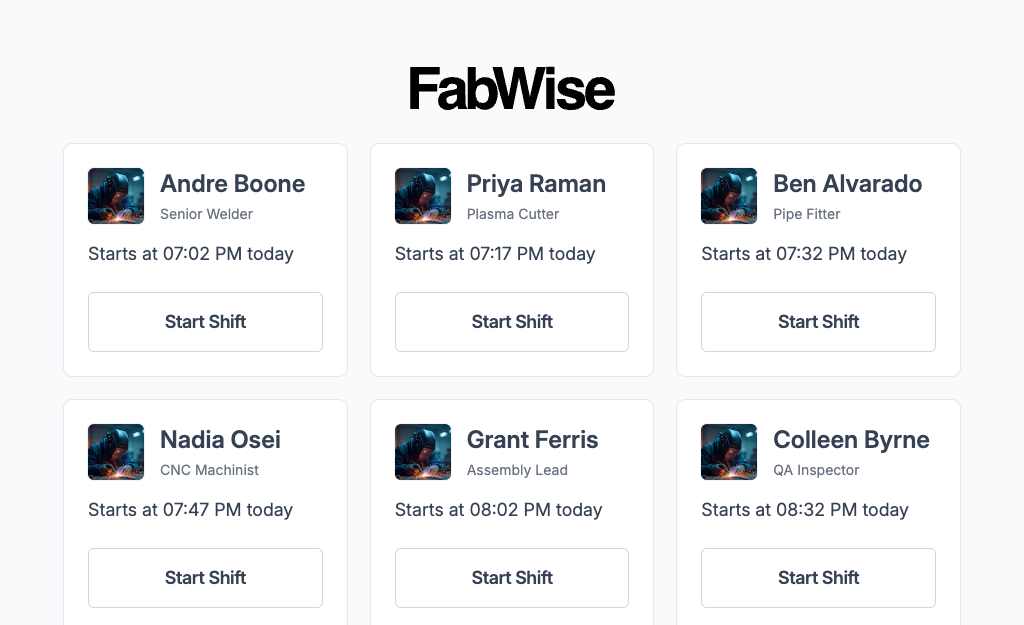
The result is a shift record that's complete at clock-out time, not at week-end reconstruction time.
What You Get Instead of the Reconstruction Step
When attribution happens on the floor as the work is done, the admin view at the end of the week shows hours per job per worker already assembled. There's no distribution to estimate, no conversations with workers about where their time went, no judgment calls about whether to round a job up or down.
Job attribution flows directly to job costing. When you close a job, the labor hours on that job are the sum of what workers actually clocked into it — not a post-hoc allocation. You can compare actual hours against estimated hours for every task on every job, in real time, not just at project close.
Payroll processing becomes a review step, not a data assembly step. Supervisors review flagged records — workers who forgot to clock out, meal breaks that don't match the schedule, segments that look unusual — and attach corrections where needed. The original record is preserved; the correction sits alongside it with an audit trail. The admin approves the period and exports.
The export is a CSV your payroll provider imports. Any system that takes one. No re-entry, no transcription errors.
What "Eliminating Paper Time Cards" Actually Means
Most shops that switch from paper to digital time tracking eliminate the paper but keep the reconstruction logic. Workers clock in and out on a terminal or app — but they clock in against their name, not against a job. The manager still has to distribute the hours to jobs at week-end, now from a digital system instead of physical cards.
That's a marginal improvement at best. The manager's reconstruction work moves from "decode this soggy card" to "run this report and divide hours by job" — but the division still happens at the end of the week, from memory or verbal report, and it's still approximate.
Genuine elimination of the paper time card problem means eliminating the reconstruction step. The system that replaces paper should make the reconstruction unnecessary — not easier.
For shops evaluating whether this change is worth the process adjustment: the payroll errors you stop making are the immediate return, and the job costing improvement — accurate historical data for every job you quote against — compounds from there. See the job costing glossary for how labor hours connect to total job cost.
What FabWise Captures — and What It Doesn't
FabWise captures accurate time records per worker, per shift, per job. It does not calculate pay, classify hours as overtime, or process payroll. Your payroll provider handles pay rates, compliance, and tax calculation from the accurate hour data FabWise provides.
The clock-in record is immutable after it lands. Corrections are a separate action with their own actor, timestamp, and reason — the original capture is never overwritten. When you export a pay period, every number is traceable to either an original capture or a named correction. There's no ambiguity about where the numbers came from.
That's what makes it a genuine replacement for the paper time card: not a digital card, but a system where attribution happens when the work happens, and nothing needs to be reconstructed afterward.