
Why this exists
Almost nobody on a shop floor has ever seen data about their own work. Office staff get reviews, dashboards, and numbers they can act on. The person running the press brake gets a conversation when something is wrong and silence when it isn't.
That asymmetry isn't deliberate — it's that nothing in the shop ever computed it. FabWise computes it as a byproduct of time capture, which means it can go to the person the data is about at no extra cost.
The premise is simple. People manage themselves better than they can be managed, if you give them the same information their supervisor has and no reason to argue with it.
What a worker sees
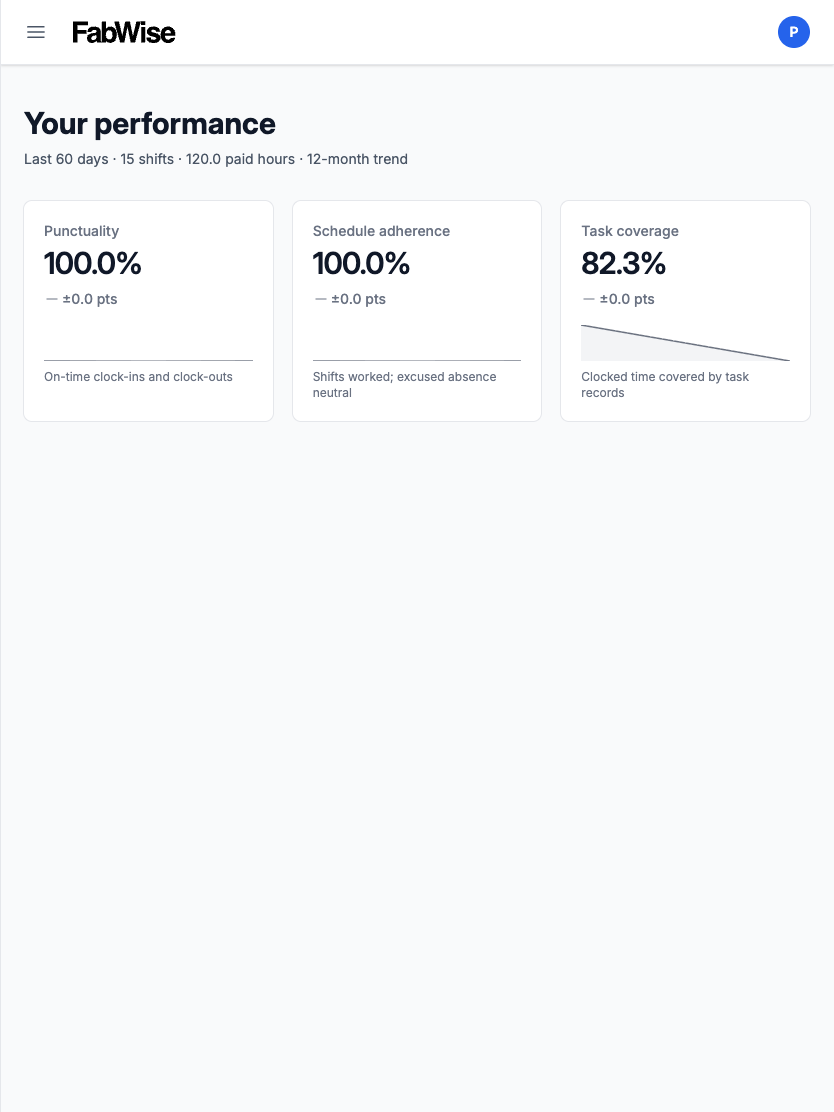
Three numbers, on the Workstation tablet, covering the last sixty days:
- Punctuality — how often they started and finished on schedule, measured against the shop's own rounding interval rather than a stopwatch
- Schedule adherence — shifts worked against shifts expected, with excused absences excluded rather than held against them
- Task coverage — how much of their clocked time is attached to a job
Each carries a plain definition and a twelve-month trend. If the shop has also enabled shop-average visibility, and there are enough active workers for the comparison to stay anonymous, they see how they sit against the shop average.
They never see another individual's numbers. The only comparison available to a worker is against the shop as a whole.
What they don't see
Everything on the supervisor's side of the wall stays there:
- The absence log and any manager notes on it
- The attendance classifications a supervisor records against a missed shift
- The closer read of how their time gets recorded — tap variance, correction burden, and the rest
- Any other worker, by name or otherwise
That boundary is enforced in the product, not by convention. The worker view is built as its own slim shape rather than the supervisor's page with sections hidden, so there is nothing to accidentally reveal.
Turning it on is a decision, not a default
It ships off. Enabling it is one switch in Settings, and it's worth thinking about before you flip it.
On a floor where people trust the numbers, it removes a whole category of awkward conversation — someone drifting late fixes it themselves in week two rather than hearing about it in month three. On a floor where the clock is already a point of friction, it can read as surveillance no matter how neutral the presentation is.
FabWise takes no position on which floor you have. That judgment is about your shop's culture, which is exactly why it's a switch and not a default.
The presentation is deliberately flat either way: no score, no grade, and no red-or-green on anything a worker self-reports. A number that arrives looking like an accusation gets argued with. A number that arrives as a fact gets acted on.
The other half of this
What a supervisor sees — the team view, the trends, the absence log — is a different page for a different reader. See attendance and punctuality.
Where this fits
This rides the Workstation tablet, the same device a worker clocks in on and tags their jobs from. The numbers come from that capture, so there is nothing extra for anyone to fill in.