
You can't improve what you can't measure
Ask a shop owner how often his crew starts on time and he'll give you an impression. Ask which of the hours he paid for last month are attached to a job, and most can't answer at all — not because they don't care, but because nothing they own has ever computed it.
That's the honest starting point. It isn't about catching people. The baseline has never existed, so every conversation about pace, staffing, or cost has run on memory and instinct.
FabWise computes it from data the shop is already capturing. Workers clock in, tag the job, take a break, clock out. The measurement is a byproduct of the time record, not a second system anyone has to feed.
The three measures
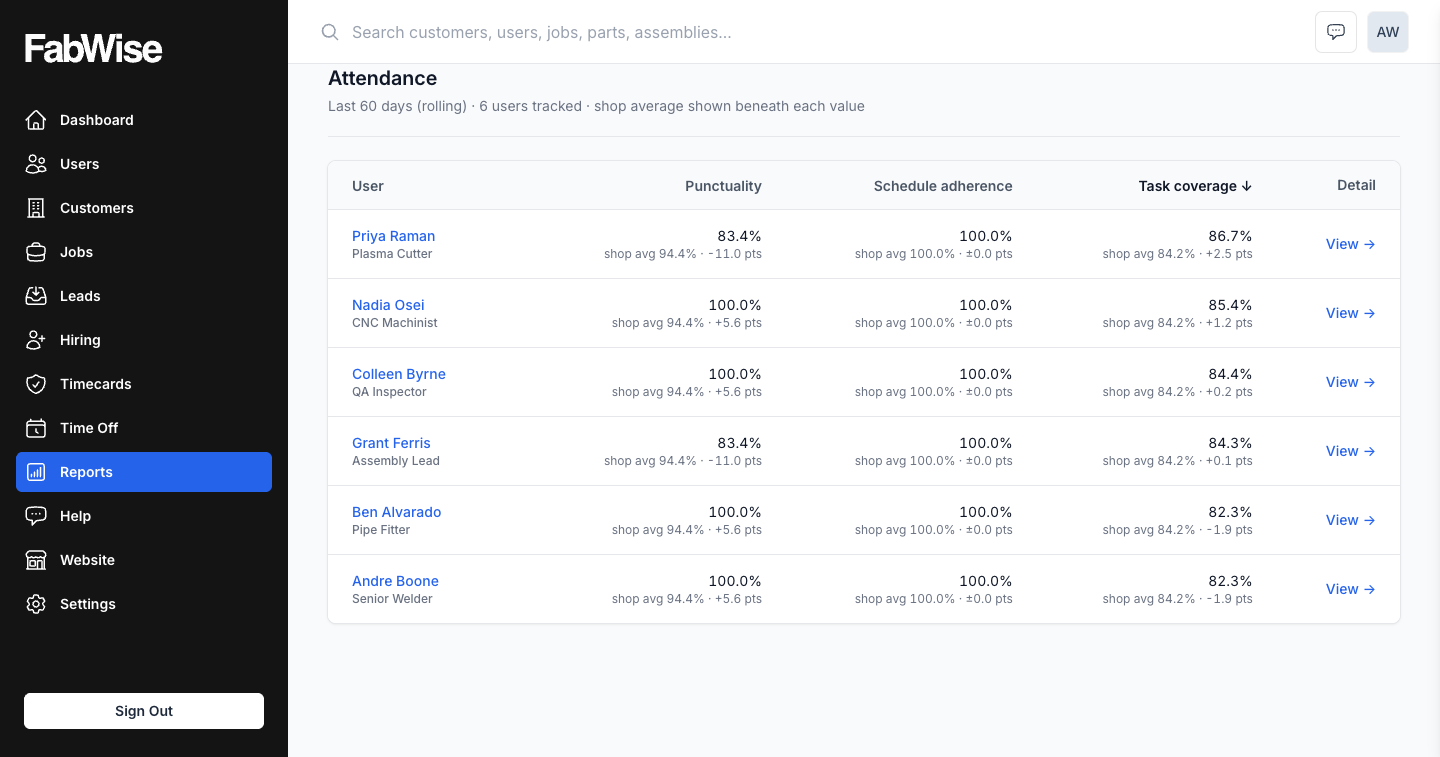
Punctuality
The share of shifts where the worker started and finished on schedule — start and end scored separately, then averaged.
Crucially, it's measured against your rounding interval, not a stopwatch. If your shop rounds to the nearest six or fifteen minutes for payroll, punctuality uses that same interval, so a worker who clocks in two minutes early is on time here exactly as they are on their timecard. One definition of "on time" across the schedule, the timecard, and this number.
Schedule adherence
Completed shifts as a share of shifts the worker was expected to work. Cancelled shifts don't count against anyone, and an excused absence is excluded rather than penalised — the metric is about shifts that were expected and didn't happen without a reason.
This is the number that answers "can I staff Thursday with the people I think I have."
Task coverage
Of the paid minutes on a shift, how many are attached to a job.
This is the one most owners feel immediately, because it's the gap between what payroll costs and what job costing can explain. A shift with eight paid hours and five hours of tagged work has three hours that are real, paid, and invisible to every job report you run. Coverage doesn't tell you those hours were wasted — setup, cleanup, and moving material are all real work. It tells you how much of your labor spend your job costing can currently see.
Alongside these you get supporting detail: average variance in minutes, average tasks per shift, and average task duration.
What FabWise will not tell you
Where your threshold is. Every shop draws the line somewhere different. A production shop running tight takt times cares about a two-minute variance; a fab shop with staggered starts and a lot of custom work reasonably does not. FabWise reports the number and leaves the judgment where it belongs.
A score. There is no 0–10 rating, no letter grade, and deliberately no red-and-green treatment on worker-facing numbers. Colour that says "you are bad at this" changes how people report their own time, and a time-tracking system that distorts its own inputs is worth nothing.
A number it can't stand behind. Each metric stays blank until enough qualifying shifts exist to make it meaningful. A worker three days into the job shows collecting, not a punctuality score computed from two shifts. No-data is a state in FabWise, not a zero.
Measured from what actually happened
Every number reads the captured time — the taps the worker made — not the corrected time.
That follows the principle the whole product is built on: capture is immutable, correction is first-class. A supervisor can and should fix a missed clock-out on the timecard, and that correction is what pays the worker. But it does not quietly rewrite the history the shop is measuring itself against, because a metric you can edit is a metric that eventually tells you whatever you want to hear.
Pay follows the correction. The baseline follows what happened.
What a supervisor sees
A team view across everyone with a time clock, sortable by any of the three measures, with the shop average shown beneath each value so a number is always in context.
Behind that sits a per-worker page carrying a twelve-month trend, the arrival and departure breakdown, and the incident-level absence log with manager notes. That log is admin and HR only. It exists on the supervisor's side of the wall and never appears on the worker's own page.
There is also a closer read of how time gets recorded — tap variance, how often a worker supplied their own start or end, correction burden, auto-ended shifts. Informational, deliberately un-scored, and useful precisely because it's invisible when you look at shifts one at a time.
The other half of this
A worker can see their own three numbers on the Workstation tablet, if the shop turns it on. That's a different page for a different reader — see what a worker sees about their own work.
Where this fits
Performance measurement is the last thing to turn on, not the first. It needs a few months of honest capture behind it to say anything true, which means it follows from getting time tracking right and running a real schedule.
Once the baseline exists, it feeds the same question everything else feeds: what the work actually costs, and what the next job should be quoted at. See job costing for the other half of that.