
Foreman uses a language model to do one narrow thing: read the data your shop already recorded — jobs, hours, schedule, due dates, leads — and write the short version of what it means today, before anyone thinks to go looking.
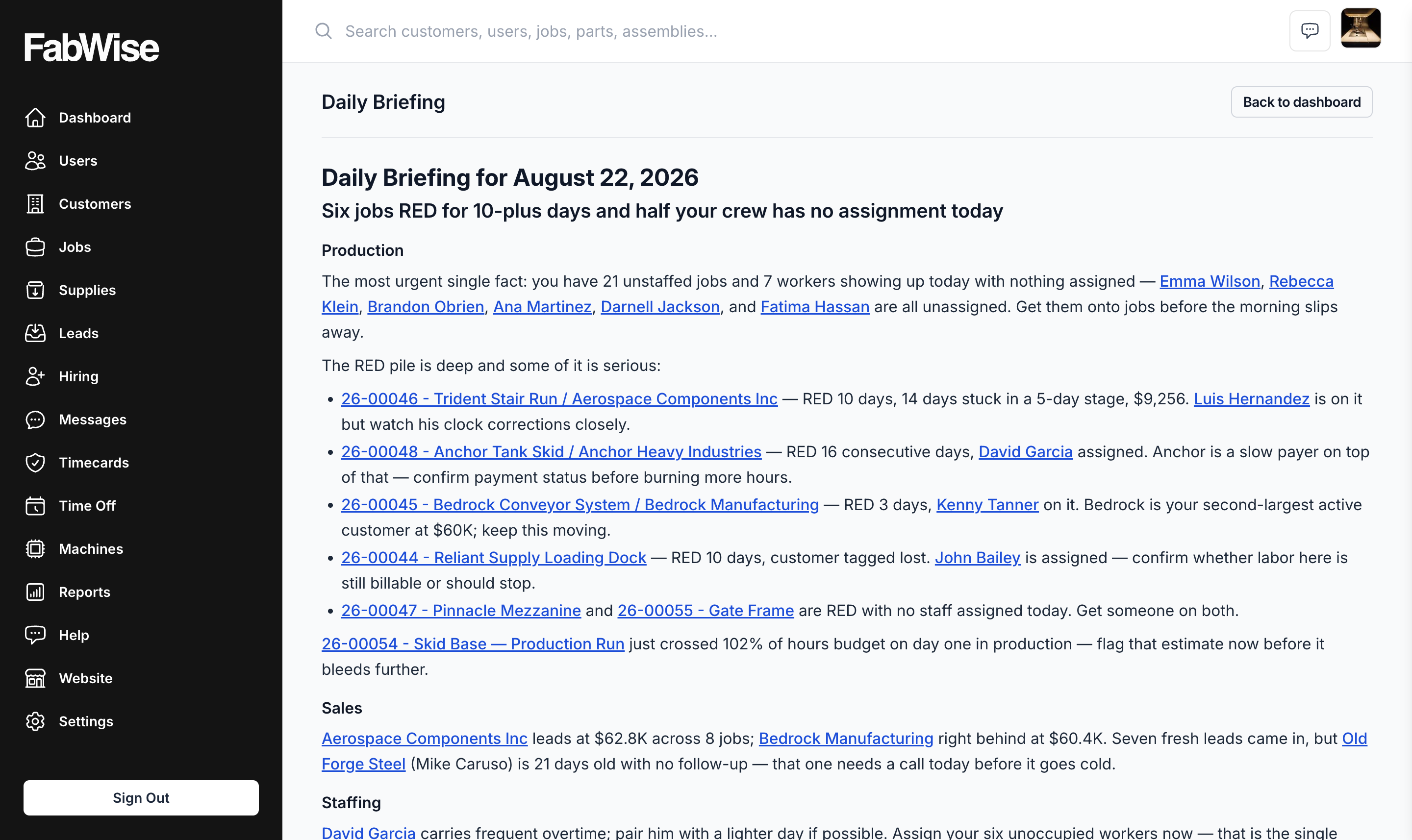
That is the whole scope. It does a few things well and it does not do a thousand others.
Being Specific About What the Model Is Doing
"AI for manufacturing" could mean vision systems on a press brake, predictive maintenance on a spindle, generative CAD, or a chatbot. Those are different products with different risks, and lumping them together is how software gets sold that nobody can evaluate.
Here is the specific version.
Your shop records structured facts all day: a worker clocked in at 6:58, a task ran three hours against job 26-00001, a quote expires Thursday, a lead came in Monday and nobody has called. Those facts are already queryable. Somebody could go find any of them.
What a language model is genuinely good at is the step after that — taking a pile of true, unremarkable facts and writing the two sentences that matter. "26-00003 has been red for six consecutive days and it is your second-largest active job." Nothing in that sentence is new information. All of it was already in the system. The work the model did was reading it all and deciding that was the thing to lead with.
That is a language problem, not a manufacturing problem, and it is the part worth automating.
Why Reports Do Not Solve This
Most systems answer this with reports and dashboards. Both share a flaw: they require someone to go look, and to know what to look for.
A dashboard shows you what you asked it to show you. It cannot tell you the thing you did not think to check on Tuesday. A weekly report arrives after the week it describes, when the useful decisions are already behind you.
The gap is not access to data. It is that reading all of it, every morning, ranking it, and noticing what changed since yesterday is twenty minutes of work that nobody in a small shop has. So it does not happen, and the job that quietly went over on Tuesday gets caught on Friday.
Foreman does that twenty minutes before the shop opens and hands over the result.
What It Reads
Each morning it takes in:
- Today's crew — who is scheduled, in which department, and when
- Active jobs — ranked by dollar value and remaining hours, with each job's stage, how long it has been there, and whether it is running over
- Anything due today — due dates, committed starts and finishes, expected closes, quotes about to expire
- Your biggest customers — where active work and dollars are concentrated right now
- New leads — waiting on follow-up, and how long they have waited
It opens with a single headline: the one thing you most need to know today. Every job, customer, worker, or lead it names is a link — read the sentence, tap the name, you are on the record.
Managing Jobs, Cost, Schedule, and Crew Is One Job
Those inputs are not a feature list. They are the questions an owner is holding simultaneously, and they interact.
A job over on hours is a cost problem this week and a scheduling problem next week, because the crew booked to start something else Thursday is still finishing this. The customer with the most active dollars is the one whose due date you least want to slip. A lead sitting four days is next month's revenue not happening.
Read separately on five screens, the connection gets missed. Read together and ranked, it is one picture.
It Remembers Yesterday
A summary that says the same thing every morning stops being read by Thursday.
Foreman keeps the last several mornings in context, so it can say a job has been red for the sixth day running, or that something moved into production yesterday. "Sixth consecutive day" is a sentence that makes someone act. "This job is over budget" is one they have skimmed five times already.
The last week of briefings is kept and readable, so when it refers to Tuesday you can go read Tuesday.
It Only Uses Your Real Numbers
This is the constraint that makes it usable in a business.
Foreman reports your shop's real data and only your real data. It does not invent anything. If a job has no price set, it says so rather than producing a plausible-looking figure.
A briefing that occasionally fabricates is worse than no briefing, because you then have to verify all of it — at which point you have saved nothing and added a risk. A tool that reports what is there and says plainly when something is missing is one you can act on directly.
What It Deliberately Does Not Do
Foreman does not run your shop. It does not reschedule anyone, reprice a job, message a customer, or change a record. It reads and it reports.
The decisions in a small shop depend on things no system holds: which welder is fastest on stainless, which customer will accept a week's slip, what somebody promised on a phone call. Software making those calls automatically gets them wrong in ways that are expensive and hard to unwind.
Surfacing the right question at the right time is the part worth handing to software. Answering it is not.
Where It Fits
Foreman is downstream of everything else. It is only as good as the hours your floor captures, the jobs and quotes those hours land against, and the schedule they are measured against.
A shop with no accurate labor data gets a briefing about nothing. That is the honest order: capture first, then costing, then the layer that reads it back to you.
The daily briefing is a Professional-plan capability, off by default — an admin turns it on for the shop, and each person turns it on for themselves.