
"As best we can"
That phrase comes up almost every time we talk to a shop about how they track hours today. There is a spreadsheet. Someone looks at it daily. They fix what looks wrong. They do their best.
Nobody says it with much confidence, because everyone involved knows what it actually means: the numbers are reconstructed. A guy tells you he got in around seven. Somebody remembers Thursday was a short day. A cell gets typed a week after the work happened, by a person who was not standing there when it did.
It works, in the sense that people get paid. It fails at everything past that.
What a spreadsheet cannot do
It cannot tell you when something is wrong. A spreadsheet accepts 7:00 for a day someone arrived at 7:40 exactly as readily as the truth. There is nothing to compare against, so nothing is ever flagged — the error and the fact look identical.
It cannot attach hours to a job. A day is eight hours in one cell. Which job those hours belong to lives in somebody's head, and by the time you are quoting the next one, that memory is the only cost history you have.
It has no version. Which copy is current, who changed the Tuesday number, and what it said before are all unanswerable. That is fine until the one time it matters, which is usually a disagreement about a paycheck.
It costs the same every single week. The daily check never gets easier. It is not a task that finishes — it is a tax on whoever owns the file, forever.
What replaces it
Capture at the moment the work happens, by the person doing it.
A worker walks in and taps their name on a tablet by the door. They pick the job they're on. They take a break, come back, and go home — tapping out on the way. That is the entire interaction, and it takes seconds.
What comes out the other side is different in kind from a spreadsheet cell:
- A record, not a recollection. The timestamp was made at the moment, by the person, on the floor.
- Hours already attached to a job, so the labor side of job costing is a byproduct of clocking in rather than a second exercise.
- Something to check against. Because FabWise also knows the schedule, it can tell you a shift started late or never happened — you get exceptions surfaced instead of a grid to scan.
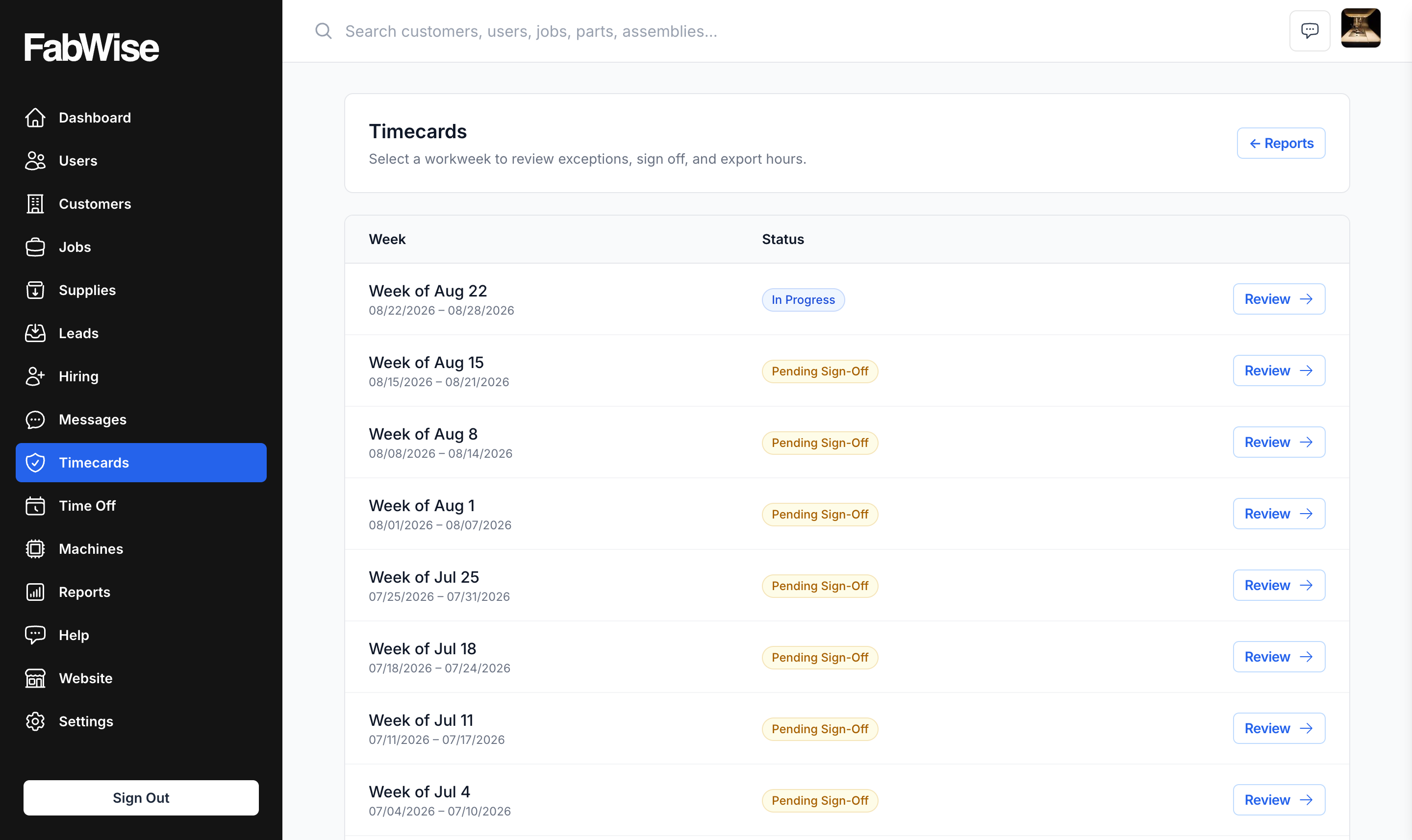
- One export at the end of the period, a row per employee, ready for your payroll provider.
The daily check becomes an exception list
The part shops feel first is not the clocking. It is that the daily review stops being a review of everything.
Instead of scanning a week of cells hoping to notice a wrong one, you see the handful of shifts that disagree with the schedule — a late start, a missing clock-out, a day nobody worked. Everything else has already agreed with itself and needs nothing from you.
That is the actual trade: not "a nicer spreadsheet," but a system where the normal case is silent and only the exceptions ask for your attention.
What it takes to switch
Less than shops expect, because the setup describes your schedules rather than your roster.
Add your people. Put them in departments. Give each department a schedule — the common shop shifts are already there as templates. Set up a tablet by the door. The work tracks how many different schedules you run, not how many people you have, so a single-shift shop is running the same day and a three-shift operation is not far behind.
There is no data migration, because there is nothing worth migrating: last quarter's spreadsheet is a record of what somebody remembered, and the value starts the first morning people tap in for themselves.
Where this fits
This is the entry point to everything else. Accurate captured hours are what make job costing real, what payroll export carries, and what attendance and punctuality is computed from. All of it rests on the hours being a record instead of a memory.